

What Is Kanji? How Is It Learned in the Japanese Language?
The Japanese language is one of the most fascinating languages in the world, known for its unique writing system and deep cultural roots. Among its three writing scripts, Kanji plays the most important and meaningful role. For learners, understanding Kanji is often the biggest challenge—but also the most rewarding part of mastering Japanese.
In this detailed guide, we will clearly explain what is Kanji, its history, evolution, usage, learning methods, and real-life examples. Whether you are a beginner or planning to study Japanese professionally, this article will help you understand Kanji step by step in a simple and structured way.
What Is Kanji?
What Is Kanji? Kanji are logographic characters used in the Japanese writing system. Each Kanji symbol carries its own meaning and often represents an idea, object, or concept rather than a sound alone.
Kanji originally came from China and were later adopted by Japan. Over time, the Japanese modified these characters to suit their own language, grammar, and culture. Today, Kanji is an essential part of reading and writing Japanese.
To understand what is kanji in Japanese language, you must know that modern Japanese uses three scripts together:
- Kanji – used for meanings (nouns, verb roots, adjectives)
- Hiragana – used for grammar and sentence endings
- Katakana – used for foreign words
Without Kanji, Japanese would be extremely difficult to read because many words sound the same but have different meanings.
Also Read: What Is Kanji? How Is It Used in the Japanese Language System?
Is Kanji Japanese?
A very common question among learners is: Is Kanji Japanese?
The answer is both yes and no.
Kanji characters originated in China, but the way Japan uses them today is completely Japanese. The meanings, pronunciations, and combinations often differ from Chinese usage.
So while the roots are Chinese, Japanese Kanji has its own identity, pronunciation system, and grammar-based usage.
What Is Kanji Used For?
Understanding what is kanji used for is crucial for learners.
Kanji is used for:
- Nouns (school, water, fire, person)
- Verb stems (eat, go, see)
- Adjectives (big, small, new)
- Names of people and places
What Is Kanji Used for in Japanese?
In daily Japanese writing, Kanji helps readers instantly understand meaning. For example:
- はし can mean bridge, chopsticks, or edge
- With Kanji:
- 橋 = bridge
- 箸 = chopsticks
- 端 = edge
This is why Kanji is extremely important.
What Is Kanji Used for in Japanese Anime?
Many learners discover Japanese through anime and wonder what is kanji used for in Japanese anime.
In anime:
- Kanji appears in subtitles
- Signboards and school names use Kanji
- Character names are often written in Kanji
- Attack names and powers use strong Kanji symbols
Anime often uses Kanji creatively to express emotion, power, and personality.
What Is Kanji Used for in Japanese Tattoo?
Another popular topic is what is kanji used for in Japanese tattoo.
Kanji tattoos are chosen because:
- One character can express deep meaning
- Symbols represent strength, love, peace, destiny, or courage
However, learning proper Kanji meaning is very important because incorrect characters can change the entire meaning.
Also Read: What Is Kanji? How Is It Used in the Japanese Language?
What Is the History of Kanji?
The history of Kanji is deeply connected to the ancient civilization of China and later to the cultural development of Japan.
In Chinese, Kanji are known as hanzi. They are written as 漢字 in traditional script and 汉字 in simplified script. The origin of these characters dates back more than 3,000 years.
The earliest evidence of Chinese characters was discovered carved on turtle shells and animal bones during the Shang Dynasty (1600–1046 BC). These inscriptions are known as oracle bone script. At that time, characters were used mainly for divination—people engraved questions on bones and interpreted cracks formed by heat.
What makes this discovery extremely important is that similar symbols appeared across different regions of China. This consistency proves that writing was not random but systematic and organized. Over centuries, these symbols gradually evolved into more structured characters.
Although civilizations such as the Sumerians developed writing earlier with cuneiform, their system eventually disappeared. In contrast, Chinese characters continued to evolve without interruption, which makes them the oldest continuously used writing system in the world.
Japan, on the other hand, is believed to have had only an oral language until around 500–600 AD. During the Yamato period, China introduced the Kanji writing system to Japan. This happened alongside the spread of Buddhism, trade, and diplomatic relations between the two countries.
Kanji proved extremely useful for Japanese society. Monks needed written texts for Buddhist teachings, government officials required records for administration, and traders needed a reliable system to document commerce. As a result, Kanji quickly became the foundation of written Japanese.
Over time, Japan adapted these Chinese characters to suit its own grammar and pronunciation, eventually creating the uniquely Japanese writing system used today.
How Did Kanji Evolve?
Kanji did not remain the same.
Evolution stages:
- Original Chinese characters
- Adaptation for Japanese grammar
- Creation of multiple readings
- Simplification after World War II
Japanese Kanji evolved to include:
- On-reading (Chinese-based pronunciation)
- Kun-reading (Japanese-based pronunciation)
This evolution explains why one Kanji can have multiple readings.
Differences Between Japanese and Chinese Kanji
Although they look similar, there are important differences.
| Japanese Kanji | Chinese Hanzi |
| Multiple readings | Mostly single reading |
| Modified meanings | Original meanings |
| Simplified differently | Different simplification |
| Used with Hiragana | Used alone |
This is why knowing Chinese does not automatically mean knowing Japanese Kanji.
What Is Hiragana and Katakana?
To fully understand Kanji, learners must also know the other scripts.
Hiragana
- Used for grammar
- Sentence endings
- Native Japanese words
Example:
- たべます (eat)
Katakana
- Used for foreign words
- Loanwords
- Brand names
Example:
- コンピュータ (computer)
Kanji provides meaning, while Hiragana and Katakana support structure.
What Is Kanji Language Words?
What is kanji language words?
Kanji words are combinations of characters that form vocabulary.
Example:
- 学生 (student)
- 先生 (teacher)
- 電車 (train)
Each character contributes meaning, making vocabulary easier to understand once Kanji is learned.
What Is Kanji Language Example?
Here is a simple kanji language example:
- 水 = water
- 火 = fire
- 山 = mountain
- 人 = person
Sentence example:
私は水を飲みます。
(I drink water.)
Kanji makes reading faster and clearer.
Japanese Kanji List and Meanings
Below is a small Japanese kanji list and meanings for beginners:
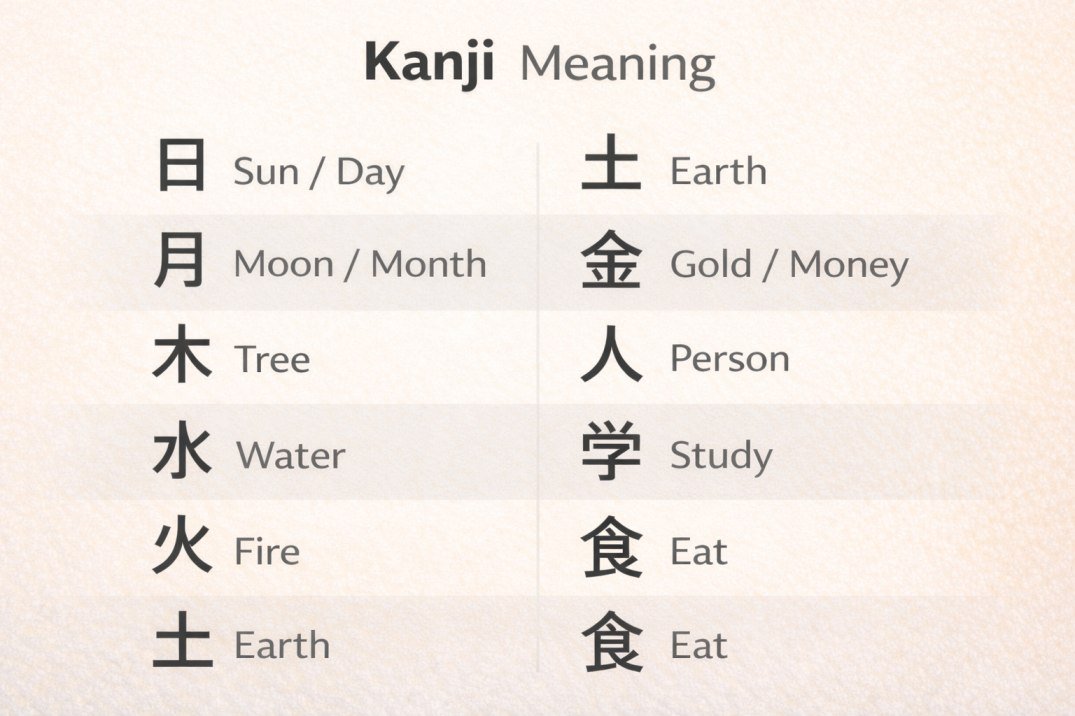
These are usually taught at beginner level.
What Is Kanji Language Dictionary?
A kanji language dictionary helps learners understand:
- Stroke order
- Meaning
- Readings (On & Kun)
- Example words
Kanji dictionaries are essential tools for serious learners.
How Can You Learn Kanji?
Learning Kanji becomes easy when done correctly.
Step-by-step method:
- Learn radicals (basic parts)
- Understand meaning before reading
- Practice stroke order
- Learn Kanji with vocabulary
- Revise daily
Studying Kanji without guidance can be confusing, which is why structured training is recommended.
Read More: JLPT 2026 Exam Dates
Learn Kanji About Japanese Food
Food-related Kanji is very interesting and practical.
Examples:
- 米 – rice
- 魚 – fish
- 肉 – meat
- 茶 – tea
- 水 – water
- 酒 – alcohol
These Kanji are commonly seen on Japanese menus and restaurants.
TLS – Japanese Language Institute is best for learning Kanji, both online and offline
If you are serious about mastering Kanji properly, expert guidance is essential.
TLS – Japanese Language Institute is best for learning Kanji, both online and offline.
TLS provides:
- Step-by-step Kanji learning system
- Beginner to advanced level training
- Practical vocabulary-based Kanji teaching
- Reading, writing, and meaning clarity
- Online and classroom sessions
Institute Details:
Website: www.teamlanguages.com
Google Map: https://share.google/Vmy1XY9yo7TfNUsP3
Address: 2/81, 2nd Floor, Lalita Park, Laxmi Nagar, New Delhi, Delhi, 110092
Phone: 087009 56038
Open Hours: 9 am – 7 pm
TLS focuses on concept-based learning rather than memorization, helping students gain long-term confidence in Japanese reading and writing.
Read More: Best Institutes in Delhi for JLPT N1 to N5 Preparation (2026 Updated Guide)
FAQs About Kanji in Japanese Language
1. What does Kanji mean in Japanese?
The word Kanji in Japanese means “Chinese characters.” In simple terms, Kanji are symbols that represent meaning rather than sound. When learners ask what is Kanji, it refers to written characters used in the Japanese language to express ideas, objects, and concepts. Understanding what is kanji in Japanese language helps learners read faster because Kanji clarifies meaning where pronunciation alone may cause confusion.
2. Why do Japanese still use Kanji?
Japanese people still use Kanji because it makes the language clear and readable. Since many Japanese words sound the same, Kanji helps distinguish meaning instantly. This explains what is kanji used for in Japanese—it avoids misunderstanding and improves reading speed. Even in modern times, Kanji remains essential in newspapers, books, anime subtitles, and official communication.
3. Is it difficult to learn Kanji?
For beginners, Kanji may feel difficult at first because each character has meaning, strokes, and multiple readings. However, with the right method, learning becomes easier. Understanding what is Kanji through radicals, examples, and vocabulary helps learners progress smoothly. Structured study makes Japanese language Kanji manageable rather than overwhelming.
4. What is 100 in Kanji?
The number 100 in Kanji is written as 百 and pronounced hyaku. This is a basic example of kanji language example used in daily life. Numbers in Japanese commonly use Kanji, especially in prices, dates, and official writing. Learning such examples helps beginners understand what is kanji used for in real-world Japanese communication.
5. Why do Japanese need Kanji?
Japanese need Kanji because their language has many homophones—words that sound the same but mean different things. Kanji provides clarity by showing meaning visually. This explains what is kanji used for in Japanese language reading and writing. Without Kanji, long sentences written only in Hiragana would be confusing and difficult to understand.
6. What is Kanji in Japanese used for?
Kanji in Japanese is used for nouns, verb roots, adjectives, names, and important concepts. It plays a major role in newspapers, books, signs, and digital media. Understanding what is kanji used for helps learners build vocabulary faster. Kanji also connects meaning directly to words, making the Japanese language more efficient.
7. Why do Japanese people say 草?
In online Japanese slang, the Kanji 草 (meaning “grass”) is used to express laughter. It comes from the letter “w,” which stands for warau (to laugh). When many “w” were typed together, they looked like grass. This shows how Japanese Kanji evolves culturally, especially in anime, gaming, and internet communication.
8. Who speaks Kanji?
Kanji is mainly used by Japanese speakers as part of the Japanese language. It is also understood by people who study Chinese characters academically. However, modern Japanese Kanji usage is unique to Japan. Anyone learning Japanese must study Kanji to read newspapers, signs, anime subtitles, and official documents.
9. Which language is Kanji?
Kanji originally comes from Chinese, but today it is an essential part of the Japanese language. This often raises the question: Is Kanji Japanese? While its origin is Chinese, its usage, pronunciation, and grammar integration are Japanese. Therefore, Kanji is best understood as a shared script with uniquely Japanese application.
10. Is Kanji difficult to learn?
Kanji is not difficult if learned correctly. It becomes challenging only when memorized without understanding. By learning meaning, stroke order, and usage together, students understand what is Kanji more naturally. With proper guidance, such as structured lessons and regular practice, mastering Japanese language Kanji becomes achievable for all learners.
Conclusion
Understanding what is Kanji is the foundation of learning the Japanese language. Kanji connects meaning, culture, history, and expression into one powerful writing system.
From its ancient origins to modern anime, tattoos, daily conversations, and professional usage, Kanji remains the heart of Japanese communication.
With the right guidance, structured practice, and expert training from institutes like TLS – Japanese Language Institute, learning Kanji becomes not only possible—but enjoyable.
Master Kanji step by step, and you unlock the true beauty of the Japanese language.


Leave Your Thought Here